


Criminal Case: Pacific Bay
4.79.63K Reviews
App Specs
- Version
- 2.45.1
- Updated On
- License
- Free
- Downloads
- 10,000,000+
- Developer
- Pretty Simple
- Categories
- Adventure
- Platform
- Android
Screenshots

 Analysis by AppCompare
I went into Criminal Case: Pacific Bay expecting a light hidden-object distraction, and that is exactly where it makes its strongest first impression. It combines crime-scene searches with a continuing adventure story, so each short session has a clear purpose: inspect a location, find evidence, question the next lead, and move the investigation forward. The setting gives the familiar formula a brighter coastal identity, while the cases provide enough narrative momentum to make “one more scene” feel tempting.
Pretty Simple has built this as a free adventure game for players who enjoy observation more than reflexes. I never felt pressured to master complicated controls. The main challenge is noticing objects in busy illustrations, remembering what the case is asking for, and deciding how carefully to spend the resources available during an investigation. That makes it approachable on a phone, especially when I only have a few minutes, although the repeated search format becomes more important as the novelty wears off.
Its audience is broad but fairly specific. If you like detective stories, visual puzzles, and episodic progress, this is an easy game to try. If you want action, deep character control, or a mystery that depends mainly on deduction rather than object spotting, it may feel too gentle. I would describe it as a casual crime adventure first and a traditional detective game second.
What the first week feels like
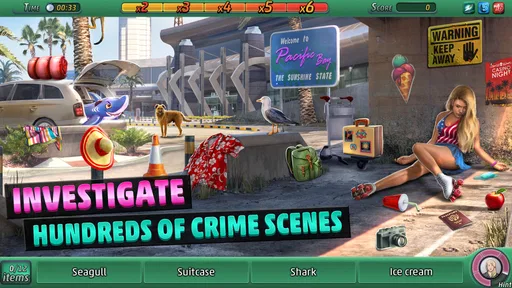
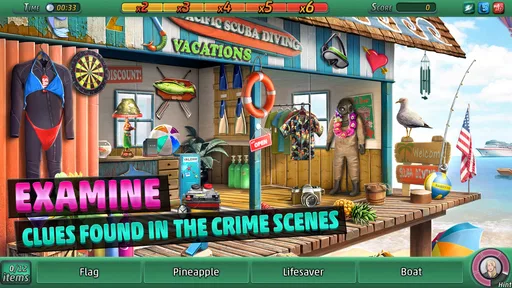
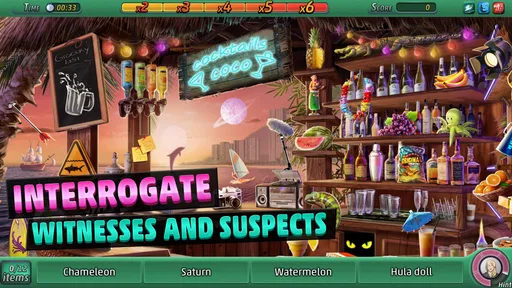
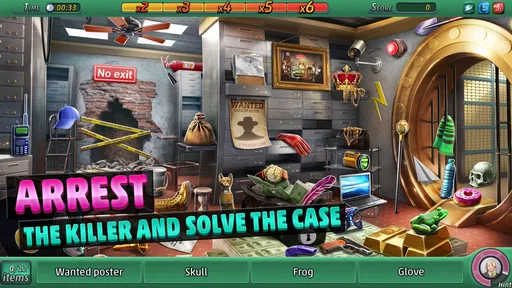
The opening hours are carried by the simple rhythm of investigation. A scene presents a cluttered image, and I scan it for the requested items. Finding an object is satisfying when it blends naturally into the background, especially when I have to slow down rather than tap randomly. After the search, the evidence feeds into the next part of the case, which gives the activity more meaning than a disconnected puzzle would have.
The Pacific Bay setting also helps the early experience. It gives the cases a recognizable atmosphere without making the game grim or difficult to follow. The tone is closer to accessible television crime fiction than to a harsh police simulator. I could play while relaxing, but there was still enough suspicion, questioning, and progression to make the investigation feel like an unfolding story.
One useful habit is to avoid rushing through every scene. I found that a quick scan is good for obvious objects, but the final few items often require a slower pass through corners, shadows, and areas where colors overlap. Tapping everywhere may occasionally help, yet it turns the search into guesswork and makes the visual challenge less rewarding. I get more from the game when I treat each location like a picture to read rather than a screen to clear.
The game is also friendly to interrupted play. A short search can fit into a commute, a waiting room, or a break between tasks. I do not need a long uninterrupted evening to understand what I am doing. That is one of its practical strengths: the story gives context to brief sessions, while the individual scenes are naturally divided into manageable pieces.
Worth Reading Before You Choose

EA SPORTS FC Mobile 26 Is a Bigger Football Game, but It Takes Time

Flipboard Shows What News Apps Must Do Beyond the Feed

Switching to Android Auto Means Rethinking Your Driving Routine

Google Calendar Makes a Crowded Week Easier to Manage

Ludo King Makes the Most of the Minutes Between Plans

Baby Panda World Brings Quick Play to Modern Phones, but Its Game Library Feels Busy
New players should expect the investigation to be guided rather than open-ended. I am not freely choosing which suspect to pursue or building a case from completely independent clues. The game leads me through its sequence, and my role is to complete the searches and follow the investigation. That structure keeps the experience clear, but it also means people looking for a branching mystery may find the freedom limited.
The age rating is Teen, which fits the crime-focused subject matter and the way the game presents investigations. I would still see it as a casual choice for older players rather than a realistic crime simulator. The emphasis remains on scenes, clues, and story progression, not on graphic detail or demanding tactical decisions.
By the end of a first-week trial, I could already tell whether the central loop suited me. The deciding question is not whether the game has enough controls or systems; it is whether searching illustrated scenes remains pleasant after the initial curiosity fades. For me, the early answer was yes, particularly when I played in short bursts and let the story provide the reason to continue.
Small decisions that improve the search
A practical approach is to read the requested object list before tapping. Some items are easier to recognize by shape than by color, and knowing what I am looking for prevents me from staring at the whole image without a plan. I also found it useful to divide a scene into zones, moving from one side to the other instead of repeatedly scanning the same central area.
When an object is nearly hidden, patience matters more than speed. I look for unusual outlines, repeated textures, and items that do not belong with the surrounding furniture or scenery. This is a modest technique, but it changes the game from frantic tapping into a repeatable visual routine. Players who struggle with hidden-object games may find that method more helpful than simply trying to react faster.
I also recommend treating energy and other progression resources as part of the session plan rather than spending everything immediately. The exact balance can vary as the investigation develops, but the general lesson is clear: a few focused scenes are more satisfying than exhausting the available actions and then feeling forced to stop. The game works best when I accept its pauses instead of trying to turn it into a continuous marathon.
What remains after the novelty
After the first month, the question changes from “Is this charming?” to “Do I still want another case?” The answer depends heavily on my tolerance for repetition. The basic activity does not disappear: I continue examining scenes, collecting evidence, and following the story. That consistency is comforting for casual play, but it also limits the sense of discovery. The game refreshes the context more easily than it transforms the underlying puzzle.
Its recurring value comes from routine rather than constant reinvention. I can open it when I want a low-pressure activity that has more direction than a random puzzle. The continuing crime theme gives each session a small narrative reward, and the case structure makes progress easy to understand. I do not have to remember a complicated control scheme after a week away.
That makes it a good companion for people who enjoy gradual progress. I would recommend it to someone who likes checking in, completing a few scenes, and leaving before the experience becomes tiring. It is less suitable for a player who needs new mechanics every few days or expects the game to become a deeper deduction experience over time.
In my everyday use, the best scenario was an evening when I had ten or fifteen quiet minutes but did not want to commit to a full game. I could investigate one location, follow the next story beat, and stop without feeling that I had abandoned a complex campaign. The same quality works during short breaks. It is a convenient middle ground between a standalone puzzle and a larger adventure that demands concentration.
The game’s audience size suggests that this format has broad appeal: it has a 4.7 average from around 251 thousand ratings and more than 10 million installs. Those figures do not change my personal experience, but they do match the feeling that the design is easy to understand and comfortable for a large casual audience. The developer, Pretty Simple, clearly focuses on making the investigation readable rather than intimidating.
Still, popularity should not be confused with universal fit. Some players will find the object lists and case progression relaxing; others will see them as a loop that repeats without enough variation. I would especially hesitate to recommend it to someone who dislikes energy-style pacing or who wants every clue to require logical deduction. The game asks me to observe carefully, but it does not turn every observation into a complex reasoning problem.
How it compares with familiar alternatives
Compared with a pure hidden-object title, this game has a stronger reason to continue because the searches sit inside a crime narrative. I am not simply clearing unrelated pictures. The case framing gives the next scene a purpose, which helps during the first several sessions and can make routine searches feel more connected.
Compared with a traditional adventure game, however, my freedom is narrower. I am not exploring a large world at my own pace or combining a wide range of objects in inventive ways. The game is more structured and more immediately accessible. That is an advantage when I want a guided experience, but a limitation when I want to solve problems through experimentation.
Compared with action-oriented mobile crime games, it is much calmer. There is no need for fast aiming or complicated movement, so it suits players who prefer visual attention to reflexes. The trade-off is that the tension is mostly narrative and observational. If I want urgency, competition, or physical challenge, another genre will serve me better.
The free entry point is important here. I can try the central experience without paying upfront, but in-app purchases range from $0.99 to $99.99 per item. That wide range makes restraint worthwhile. I would not spend simply because a session slows down; I would first decide whether the game has genuinely earned a place in my routine. For a casual title built around short investigations, waiting or returning later is often a better choice than treating every pause as a problem to buy away.
Maintenance, friction, and reasons to stop
The maintenance burden is fairly low in terms of learning. With the current version at 2.45.1 and support beginning at Android 7.0, the game is positioned for a wide range of Android devices that meet that requirement. Once I understand the search-and-investigate rhythm, I do not need to relearn it after a break. That makes it easy to keep installed for occasional use.
The larger burden is attention. Hidden-object scenes can become visually tiring, especially when I play several in a row. The same careful scanning that feels satisfying at first can start to feel like work when my eyes are tired. I get better long-term value by limiting sessions and stopping after a natural case beat rather than pushing through a string of similar searches.
Another source of friction is the balance between curiosity and pacing. When progress slows, I may feel tempted to use a purchase or wait for the next opportunity to continue. That can interrupt the story’s momentum. My advice is to treat the game as a patient pastime, not as a campaign that must be completed quickly. The design is more comfortable when I accept its cadence.
Repetition is the most serious long-term limitation. The setting and case details can change the mood, but the act of finding objects remains familiar. Players who enjoy mastery may appreciate learning to scan more efficiently, while players who need constant novelty may stop once the pattern becomes obvious. Neither reaction is wrong; it depends on whether repetition feels soothing or stale to you.
I also would not choose it as my main game if I wanted a rich social experience, competitive rankings, or deep customization. Its appeal is personal and guided. I open it to investigate, not to build a large identity inside a shared world. That narrower purpose is part of its charm, but it also defines its limits.
For someone deciding whether to keep it installed, I suggest a simple test: play across several separate days rather than judging it during one long session. Notice whether you look forward to the next case or merely continue because the previous one is unfinished. If the story keeps providing a reason to return, the game can become a pleasant habit. If the searches already feel like a chore, more content will probably not solve the underlying mismatch.
My long-term verdict
Criminal Case: Pacific Bay earns lasting space for me as an occasional, low-pressure adventure rather than as an all-day game. Its first-week appeal is clear: the crime setting gives hidden-object puzzles a purpose, the controls are approachable, and the short investigations fit naturally into ordinary breaks. I like that I can make progress without preparing for a demanding session.
Its month-to-month value is more conditional. The story structure can keep me interested, but the central search loop eventually asks whether I enjoy familiarity. The game does not completely escape the repetition built into its format, and the pacing can become less comfortable when purchases appear to offer a shortcut. I recommend patience and short sessions, especially for anyone playing free.
My strongest recommendation is for fans of casual detective fiction who want visual puzzles wrapped in an ongoing adventure. It is also a good choice for someone who wants a game that can be paused easily and resumed without remembering complicated systems. I would skip it if I need branching investigations, demanding deduction, action, or frequent mechanical surprises.
The free price makes trying it straightforward, while the Teen rating and accessible presentation give a clear idea of its audience. Just keep the in-app purchase range in mind and decide in advance whether you are comfortable waiting instead of paying when progress slows. That one boundary can make the difference between a relaxing pastime and a frustrating habit.
After the novelty fades, this remains a dependable niche game: not endlessly fresh, but easy to return to when I want a guided search and a small piece of crime-story momentum. Its lasting value comes from dependable short sessions, not from unlimited variety. If that sounds like the kind of routine you enjoy, Pretty Simple’s Pacific Bay investigation is worth keeping around.
Pros
- Engaging hidden-object investigations with varied crime scenes.
- Episodic cases provide a clear sense of progression.
- Colorful Pacific Bay setting gives the game visual personality.
- Simple controls make it accessible on phones and tablets.
- Regular objectives and rewards encourage short daily sessions.
Cons
- Energy limits can interrupt investigations at inconvenient moments.
- Some evidence searches become repetitive after extended play.
- Progress may feel slow without spending premium currency.
- Requires an internet connection for most gameplay features.
- Ads and optional purchases can affect the otherwise smooth experience.
FAQs for Criminal Case: Pacific Bay
What is Criminal Case: Pacific Bay?
Criminal Case: Pacific Bay is a hidden-object adventure game in which you investigate murder cases in a tropical setting. You examine crime scenes, search for clues, question suspects, analyze evidence, and eventually identify the culprit. It combines detective storytelling with casual puzzle mechanics, making it suitable for players who enjoy episodic mysteries rather than fast-paced action games.
How do you play Criminal Case: Pacific Bay?
Each investigation usually begins with a crime scene that must be searched for specific objects. Finding items quickly and accurately improves your score, while collected clues help you unlock forensic tests and interrogations. You then follow the evidence through several stages until the case is solved. The game is easy to learn, although later scenes can require patience and repeated attempts.
Is Criminal Case: Pacific Bay free to download and play?
The game is generally free to download and play, but it includes optional in-app purchases. Energy, investigation attempts, boosts, or other resources may limit how quickly you can progress, especially during longer play sessions. You can continue without paying by waiting for resources to refill and completing available activities, but players who want faster progress may encounter purchase offers.
Does Criminal Case: Pacific Bay require an internet connection?
An internet connection may be needed for features such as loading investigations, synchronizing progress, displaying advertisements, processing purchases, and accessing online services. Availability of offline play can vary depending on the device and current version of the game, so it is best not to assume that every feature will work without a connection. A stable connection also helps prevent progress-sync problems.
Is Criminal Case: Pacific Bay suitable for children?
Criminal Case: Pacific Bay uses cartoon-style visuals and simple point-and-click gameplay, but its stories focus on murders, investigations, suspects, and crime scenes. The presentation is not designed as a realistic crime simulator, yet some themes may still be unsuitable for younger children. Parents should check the current age rating, review in-app purchase settings, and consider whether mystery and crime content is appropriate.


